
Churning about creative hobbies
And learning about my research

Churning about creative hobbies
What follows is the short(ish) summary of my research into creative hobbies for the working population, which I conducted as part of my Organisational Psychology MSc at City St George’s, University of London.
It was inspired by my own experiences of discovering creative hobbies in 2018 when I suddenly felt the need to embroider something.
I was in the post-graduation job hunting era and so I was seeking something to make me feel productive, keep my hands and my mind busy, and potentially give me a cheap option for Christmas presents for my large and ever growing family. However, I considered myself firmly ‘not-artistic’, and at that time very much felt that ‘being artistic’ involved some kind of X-factor that if you didn’t possess at birth, you couldn’t acquire.
But I really wanted to do something, and embroidery felt a bit like dot-to-dot with needle and thread. I could find a template to follow, join the dots, and I’d have something to show for it. It didn’t rely on any actual creativity from me, just the capacity to follow instructions. Add in my exposure to various Jane Austen TV adaptations over the years, and before I knew it I was searching the shelves of Crafts ‘N’ More to find what I needed for my first project - and lo and behold, I was soon bringing my own ideas to life.
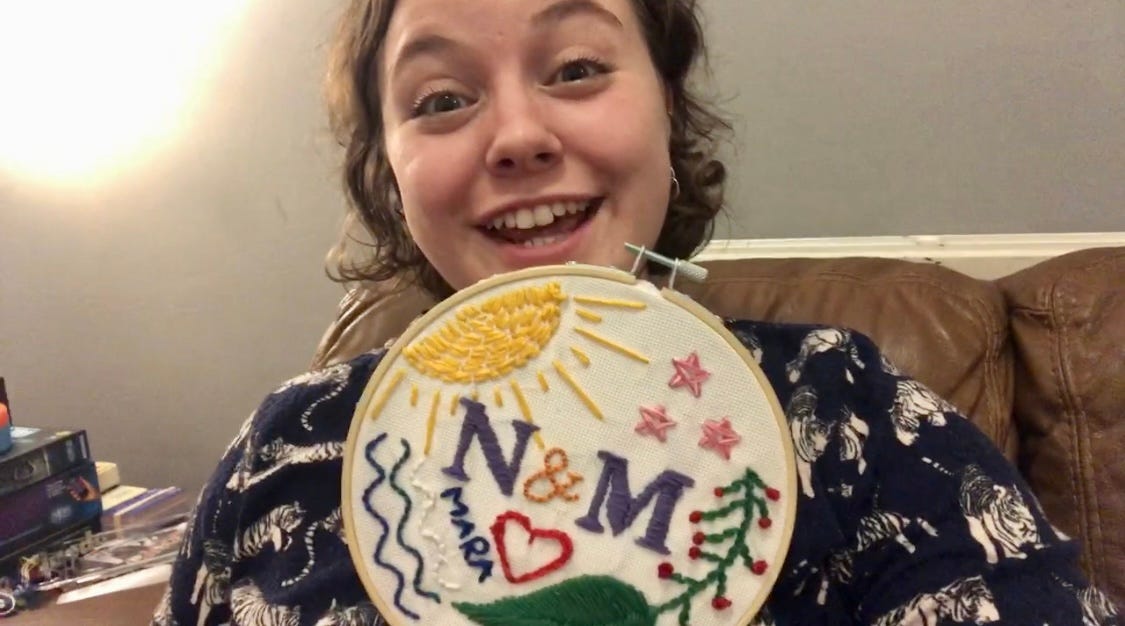
Last week I wrote about urge surfing, and how it can help us cope with unhelpful impulses. But this impulse to craft, to create, to try something new, was one worth acting on. It turned out to be the first step in discovering that the creative X-factor is in fact something we all have, and can uncover if we want to.
This research not only helped me understand my personal experiences better, but contributes to my efforts to understand how to support individuals to thrive at work, at home, and within themselves.
Learning about my research into creative hobbies

Recuperating, Revitalising, and Reaffirming: the experiences associated with creative hobbies, and their impact on recovery, wellbeing, and work.
As rates of depression, anxiety, and burnout continue to rise in employees, organisations are keen to find ways to support their workers to thrive (Chartered Institute of Personnel and Development, 2025). One way to do this is to help employees to recover from work and in turn support their wellbeing and performance (Sonnentag et al., 2022) through effective leisure time activities (Petrou & de Vries, 2025).
Some psychologists have focused on the need to recover from effort spent at work (Meijman & Mulder, 1998)and others have described the need to invest resources to gain more back (Hobfoll, 2018). Sonnentag and Fritz (2007) identified four key experiences for recovery: Relaxation, Control, Mastery (learning new skills and feeling competent), and Psychological Detachment (switching off from work). Newman et al. (2014) built on this and developed the DRAMMA framework which identified five wellbeing needs that leisure activities should satisfy: Detachment-Recovery, Autonomy, Mastery, Meaning, and Affiliation. The addition of Meaning and Affiliation was based on wellbeing research that emphasised how important they are for creating a deep sense of life satisfaction and optimal functioning, also known as eudaimonia (Ryff, 1989).
Research suggests creative hobbies offer many of the essential recovery and wellbeing experiences identified by Sonnentag and Fritz (2007), and Newman et al. (2014) (from Eschelman, 2014; Alameer et al., 2023). Furthermore, people who engage in creative hobbies during their leisure time not only feel better, but they also perform better at work and in their personal lives (de Bloom, 2018). Creative interventions have been found to be cost effective and are often more accessible than other recovery activities (WHO, 2019). This demonstrates that employees engaging in creative hobbies can benefit organisations as well. Despite this, creative hobbies have been somewhat overlooked in the employee recovery and wellbeing literature, and although rates of people engaging in at-home creative hobbies are rising, it appears that creative hobbies may be an underused tool for supporting employee wellbeing and recovery.
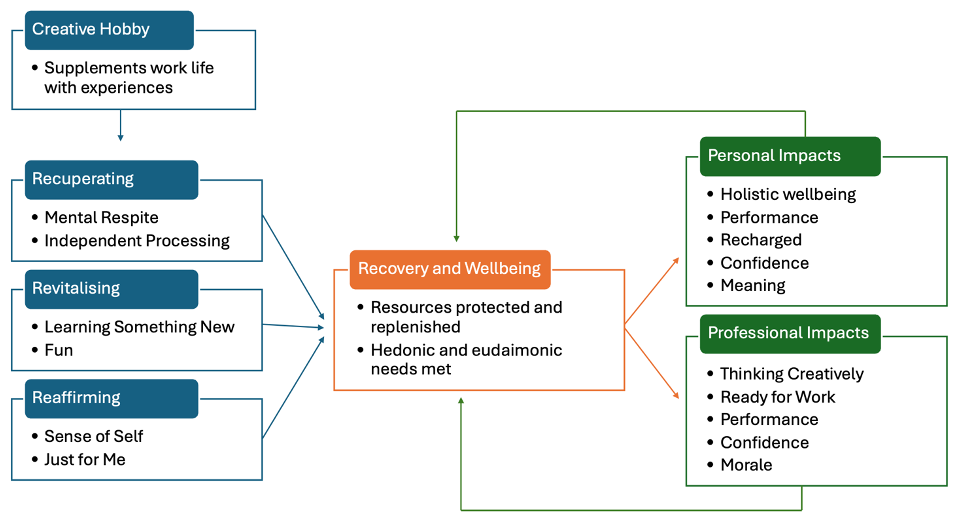
I set out to address this gap by asking creative hobbyists about their experiences during their hobbies, and to share insights into the impact on their wellbeing and experiences at work. I interviewed 18 participants who had creative hobbies, asking questions about the hobby itself, their jobs, and the relationship between the two aspects of their lives. I used a Thematic Analysis to analyse their responses, which is a technique in qualitative research that involves carefully reading the transcripts, labelling quotes with different ‘codes’, and then exploring ways to group those codes together into themes that meaningfully reflect the participants’ feelings. At the end of this process, I had identified three key themes titled Recuperating, Revitalising, and Reaffirming, which each represented two experiences and two impacts of the creative hobbies.
The Recuperating experience of Mental Respite was linked to the concept of Psychological Detachment, as participants talked about switching off, relaxing, and de-stressing after work. Some of them used their hobby as a chance to Independently Process their feelings from the day and make plans for the next one. These experiences meant the participants felt Recharged and Ready for Work.
The Revitalising experiences aligned more closely with COR (Hobfoll, 2018) as even though participants had used lots of resources at work, they still dedicated more time and energy to their hobby to Learn Something New and have Fun. Learning Something New met their need for Mastery, as they described using a different part of their brain, flexed their creative muscles, and became more accepting of mistakes. This experience developed their Creative Thinking and contributed to them feeling more Confident at work. A creative hobby was sometimes a chance to have Fun with others, but for many of the participants, they had the feeling of “childlike excitement” even on their own. This experience of enjoyment can be described as hedonia, the aspect of wellbeing associated with pleasure and a good mood (Deci & Ryan, 2008). Hedonia can be short-lived, and alone it does not account for the longer-term gains in wellbeing that people need to feel a true sense of life satisfaction (Ryff, 1989). Nonetheless, hedonic wellbeing is still worth supporting, and this finding is an important one for understanding how to motivate people to take up creative hobbies.
The final theme, Reaffirming, is more related to the other aspect of wellbeing, known as eudaimonia. Ryff’s (1989) model of eudaimonic wellbeing identified six components: Autonomy, Purpose, Mastery, Self-Acceptance, Positive Relationships, and Personal Growth. Having a chance to do something ‘Just for Me’ and Reaffirm their Sense of Self clearly supported the components of Autonomy and Purpose, as well as Self-Acceptance and Personal Growth, leading to a spill over effect that contributed to improved Morale at work and better Personal and Professional Performance. The participants described a sense of holistic wellbeing and satisfaction due to engaging in their hobbies. For some, this was essential and helped them cope with the demands of work, and for others it made an already pleasant job even more enjoyable.
Based on these findings, Figure 1 illustrates a proposed framework for the experiences and impacts of creative hobbies and highlights the spill over effects from wellbeing and recovery into people’s professional and wider personal lives.
Figure 1
A framework for the experiences and impacts of creative hobbies
More research is needed to fully understand what creative hobbies offer employees and organisations, and it will be particularly important to study different groups of individuals to uncover any relationships between personality, neurodivergence, and the uptake and impact of creative hobbies. Equally, future research should seek to understand the way job traits influence the recovery experiences employees seek out.
This study contributes to the literature demonstrating that creative hobbies can have a significant impact on employee wellbeing, recovery, and performance. Not only do they offer similar experiences to other leisure time activities, meeting the needs for recovery and wellbeing, but they may offer unique advantages such as mindful Independent Processing and the chance to have Fun.
Government health policies should incorporate creative hobbies as a means of supporting general health and wellbeing, with particular focus on the otherwise healthy working population as a preventative measure. Social prescribing, where people are helped to find social groups to support their health and wellbeing, is an established strategy in the NHS (CIPD, 2025), and creative prescribing could be an important branch of this going forward.
Organisations can put these findings into action by:
Spotlighting and celebrating creative role models in the organisation to establish a culture of creative recovery, and encourage other employees to have a go
Sharing information about the psychological underpinning of creative hobbies and the impacts they can have on wellbeing and performance, emphasising the variety of creative activities and the different experiences they can offer
Offering flexible working hours to support employees to take part in creative activities more easily
Supplying vouchers for materials and resources to make creative hobbies more accessible to all
Running creative wellbeing initiatives within the organisation to develop a collaborative culture of creativity
Develop and deploy a toolkit to assess any creative health needs in their employees and meet those needs proactively in and out of the work context.
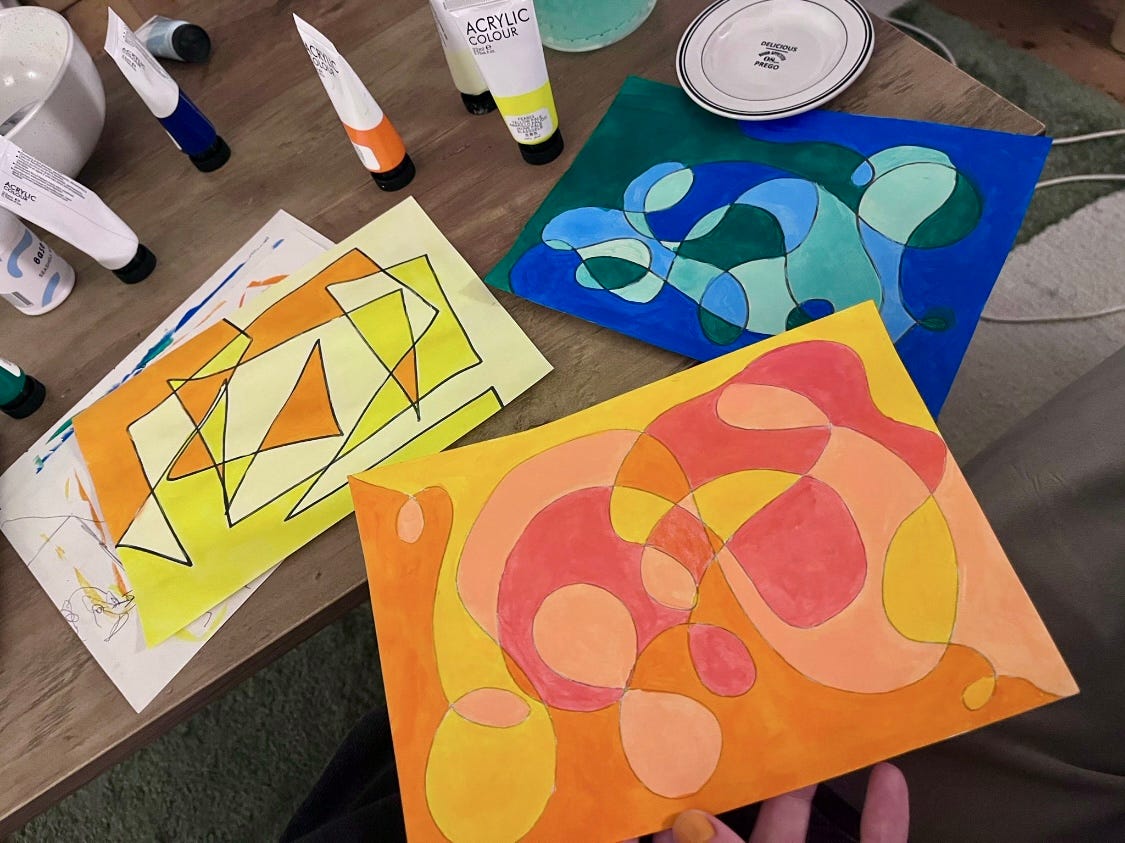
Finally, individuals can find their own ways to recuperate, revitalise, and reaffirm themselves through creative hobbies. There are many stand-alone workshops or regular classes taking place every day across the country for those that want to get out and craft with others or have the support of a teacher to guide them. the at home craft kit industry has been booming since 2020, and so there are endless options from pottery, to painting, to printmaking that can be played with from the comfort of your own home.
Even something as simple as taking a pen and paper and making marks to your favourite music can offer some of these beneficial experiences, and may open the door to more creative pursuits in the future.
If you would like to read the full version of this research, here it is again for you!
If you enjoyed this piece, please share it with your circle
Next week I will be sharing my reflections on adventurousness and the time I met Stanley Tucci… subscribe to The Churnal to find out when that’s out
Is there anything you’re churning about? offer 1:1 coaching, team coaching, and creative wellbeing workshops. If you would like to find out more about working together, please email me at doloresmrhill16@gmail.com or connect with me on LinkedIn.
Until next time!
Dolores